A supplier file mentions a UL Recognized power module inside a control box. Your import turns that into "UL Listed: Yes" on the box's product page. Now a buyer filtering for certified equipment may shortlist the box based on evidence that covers only one part inside it. Industrial catalog teams can prevent that leap by keeping each certification claim attached to the exact product, component or assembly named in its supporting record.
Key takeaways
- Keep component recognition separate from a claim about the finished product. A component's evidence does not automatically cover the assembly containing it.
- Record what the claim covers, its conditions and its source before choosing a filter value or writing a badge.
- Treat missing or conflicting evidence as unresolved. Do not turn an unanswered certification question into either "Yes" or "No."
Start with what the evidence covers
The first question is practical: which object did the certification body evaluate? It might be a power supply, an enclosure, an enclosed control panel or a complete machine. Those objects can appear in the same supplier file without sharing the same certification scope.
UL's component recognition guidance says recognized components are intended for use within larger products. Their conditions of acceptability describe how they may be used, including housing, wiring or temperature limits. Recognition therefore needs to stay with the component and its conditions, rather than becoming a finished-product claim.
UL's control-panel guidance gives a second example. Certification of an enclosed industrial control panel covers the panel, not the connected loads it controls. An enclosure-only certification has a narrower scope. A single "UL approved" field hides these differences from buyers comparing products.
Also preserve the language on the applicable record. "UL Certified" is not inherently wrong: UL's enhanced Mark guidance explains that Certified can encompass Listed and Classified. Check the covered object, service, geography and identifier instead of rejecting or rewriting the term by itself.
Keep the power module separate from the box
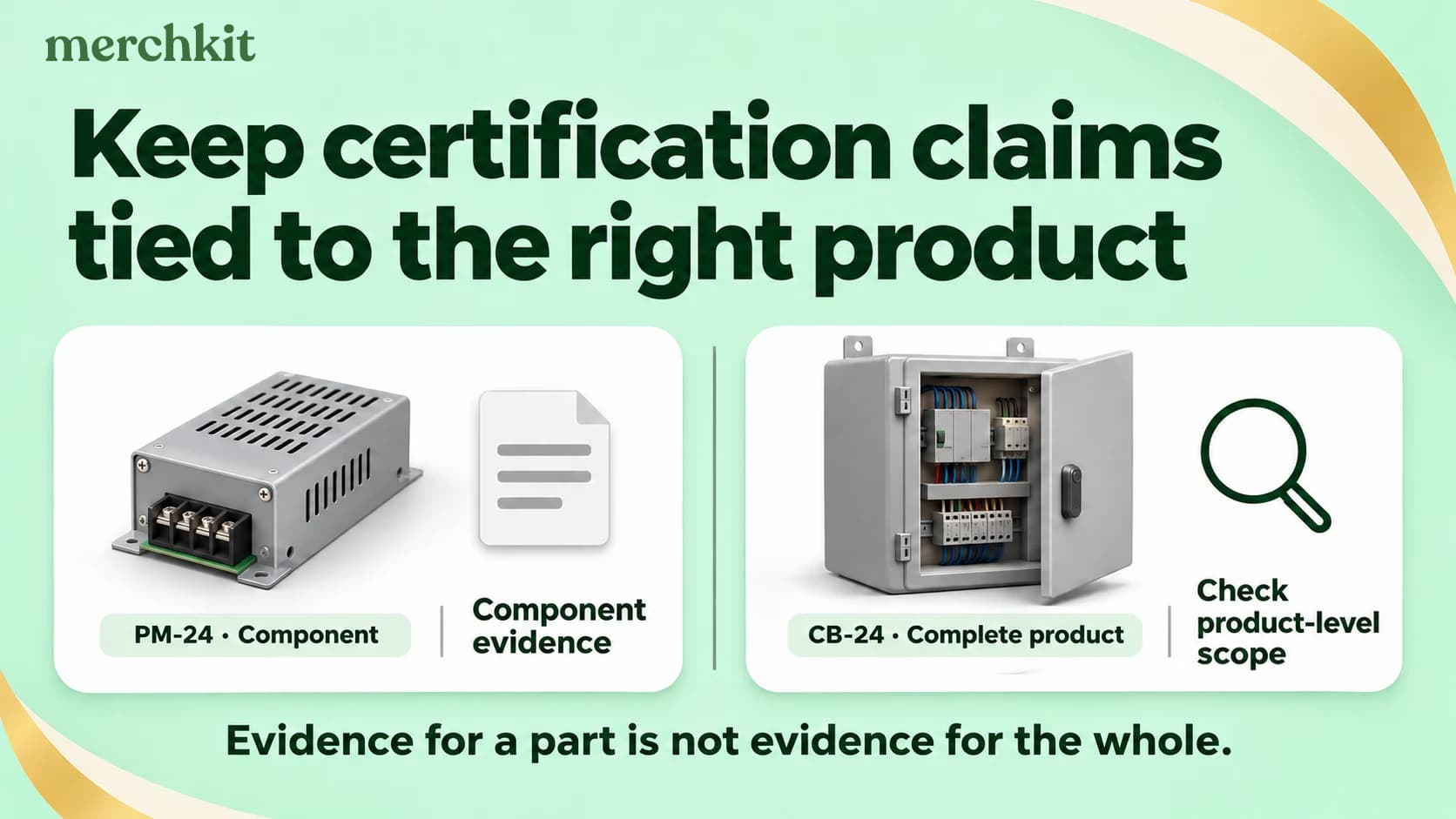
Suppose your catalog sells control box CB-24, which contains power module PM-24. The supplier sends a recognition record identifying PM-24. No evidence supplied so far establishes a certification claim for CB-24 as a complete box.
The import's "UL Listed: Yes" value on CB-24 needs review. Save the module's recognition information with PM-24, including the record and conditions. Keep the relationship showing that CB-24 contains that module, but leave the box's own claim unresolved until the supplier provides applicable evidence.
That distinction matters even if the buyer can order only the box. You can retain a component-level evidence entry without pretending the module is a separately sellable SKU.
For a description, a reviewer might approve "Contains UL Recognized component PM-24" after confirming the source, component match and relevant conditions of acceptability. That wording should not silently become "UL Listed control box" in a title or comparison table. The unresolved box record also does not prove the box is uncertified; it records a gap in the evidence your catalog team has checked.
Build a claim worksheet before writing copy
Use one worksheet row per claim and covered object. The following fields are a starting point for manual review, not a universal certification schema. Record what the evidence actually provides and flag missing details that prevent your team from approving the wording.
| Field | What to keep |
|---|---|
| Covered object | Component, enclosure, panel or finished product, with the exact model and configuration. |
| Certifier and service | The named organization and the service or mark wording shown in the evidence. |
| Standard | The standard and edition exactly as stated, without supplying an assumed edition. |
| Geography | The market or geographic scope supported by the record. |
| Identifier | File, certificate or other identifier; include a serial number when the coverage is specific to one unit. |
| Conditions | Stated limitations and references needed to interpret the claim. |
| Source and date | Document or URL, page or section, source date or revision if given, and date checked. |
| Review decision | Approved wording or unresolved question, with reviewer and review date. |
Model matching alone may not be enough. UL describes limited-production equipment certification that applies to a particular piece identified by a serial number or another discrete identifier. Do not copy that evidence to every item with the same model number.
For CB-24, the worksheet should make the two decisions easy to see: PM-24 recognition has its own evidence; the complete-box claim still needs support. If the record omits a date or edition, preserve that absence rather than guessing. A date checked helps the next reviewer understand when the source was consulted; it is not an invented expiration date.
Check what buyers will actually see
Review a sample of outputs against the worksheet before applying the same mapping across a supplier catalog. A correct internal record can still become misleading when a template shortens it.
Test the CB-24 example in four places:
Filters: does a finished-product certification filter return the box because of its component claim?
Titles: did shortening the description remove "component" or replace Recognized with Listed?
Badges: does a badge appear to cover the complete box when the evidence names only PM-24?
Descriptions: can the reader tell which part the claim describes, with the relevant qualifications retained?
Include one unresolved record in the test. It should remain unresolved internally and should not produce an unsupported public claim. Ask the supplier or the person responsible for certification evidence to settle disputed scope before approving the wording.
How this gets done in Merchkit
Bring the CB-24 record, component evidence and proposed channel copy to a Merchkit demo. Use the sample to evaluate Merchkit's catalog enrichment and channel-content workflow:
Keep buyers' comparisons accurate. Check whether the proposed workflow can retain component evidence without promoting it to a claim about the complete product.
Reduce repeated supplier-file work. Test how recurring claim labels and supporting records would be prepared, and identify what still needs manual interpretation.
Make review easier. Ask how reviewers would find the source, its conditions and the unresolved question together before approving content.
Preserve the claim in channel content. Compare proposed titles, descriptions and filter values with the approved worksheet, including what happens when evidence is missing.
Book a demo with one supplier certification example to evaluate the work your team can simplify and the decisions it needs to keep under review.
Frequently asked questions
Does a UL Recognized component make the finished product UL Listed?
No. Component recognition does not establish certification of the complete product containing it. Keep the component's identity and conditions of acceptability with its record, then seek applicable evidence for any finished-product claim. UL's component recognition guidance distinguishes these scopes.
Is the wording UL Certified incorrect when a record does not say UL Listed?
Not necessarily. UL explains that Certified on its enhanced Mark can encompass Listed and Classified. Preserve the applicable service and scope instead of automatically replacing Certified with Listed or rejecting it. Check the record's product identity, geographic scope and identifier. UL enhanced Mark guidance
Does certification of an enclosed control panel cover the machinery it controls?
No. UL distinguishes an enclosed panel's coverage from the connected equipment it controls; an enclosure-only certification is narrower still. Keep those objects separate when building catalog filters and badges. A panel claim must not become a whole-machine claim without supporting evidence. UL control-panel scope guidance
Can I reuse a certification record for every unit with the same model number?
Do not assume that model matching establishes coverage. UL's limited-production certification can apply to a particular piece identified by a serial number or another discrete identifier. Preserve that identifier and verify the record's scope before applying the claim to other units. UL limited-production guidance
Should a missing certification document produce a No value in my catalog?
No. Missing evidence means your team has not established the claim; it does not prove the product is uncertified. Keep an internal unresolved status and the question that needs clarification. Withhold unsupported public claims while the supplier or certification-evidence owner supplies the applicable record.
How do I stop a correct component claim becoming a misleading product badge?
Keep the covered object and certification wording attached to the approved claim through every output mapping. Test the title, filter, badge and description separately, including an unresolved example. If a template drops the component qualification, correct that mapping before use. This review checks catalog wording; it is not a certification or safety assessment.