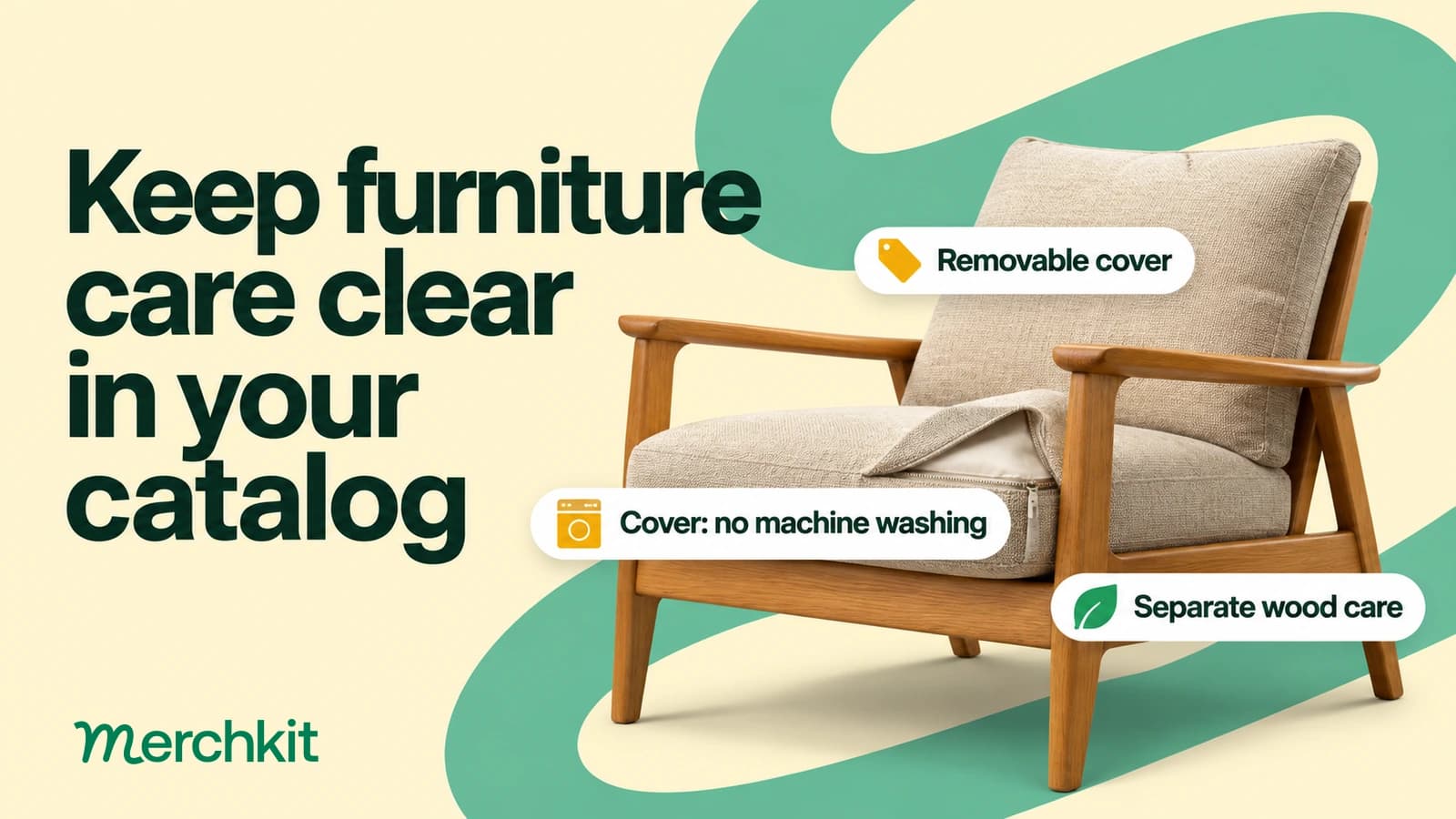
A furniture listing should tell buyers what they can clean, how they can clean it, and which restrictions apply. A single “easy care” field cannot explain a chair with upholstered cushions and an oiled wood frame. When catalog teams collapse those instructions into one sentence, buyers may mistake removable covers for washable ones or apply a wood treatment to the wrong surface. Keep each care instruction attached to the component and finish it actually covers.
Key takeaways
Record removability and machine-washability separately. One does not establish the other.
Keep the cleaning method, restrictions and source with the specific cover, upholstery or finished surface.
Check short descriptions and filters as carefully as the full care guide. A shortened claim still needs its qualifications.
Removable does not mean machine washable
A zipper answers a construction question, not a cleaning question. Room & Board’s upholstery guide warns against machine washing cushion casings because the fabric, backing or stitching may be damaged. Its cleaning-code section also distinguishes solvent-based from water-based cleaning products. Neither a removable casing nor a water-based cleaning code is, by itself, a machine-washing instruction. Room & Board upholstery care
Other products do have explicit washing instructions. IKEA’s UK page for the MANNARP three-seat sofa cover in Gunnared beige, article 806.116.00, permits a normal machine wash up to 40°C. It also specifies separate washing and prohibits bleaching and tumble drying. Those directions belong to that cover, not every sofa with removable upholstery. IKEA MANNARP cover care
For a retailer, the useful distinction is between a feature and an approved care method. Store “cover removable” independently from “machine washable.” If the supplier confirms only the first, leave the second unresolved. Do not convert missing evidence into either a positive claim or an assertion that washing is prohibited.
Match wood care to the finish
Knowing that a frame is oak does not identify its care instructions. Room & Board separates its guidance for lacquered, acrylic-finished, painted or stained wood from guidance for oiled or oil-and-wax finishes. The latter includes periodic treatment; the former warns against furniture polish accumulating on the surface. Copying one generic wood-care paragraph across both groups would erase that distinction. Room & Board wood care
Mixed-material pieces need another check: can caring for one component affect its neighbor? Room & Board’s guide for fabric furniture with oil-and-wax finished wood tells owners to protect the fabric before treating the wood. That precaution disappears if an editor extracts only the wood-treatment sentence. Room & Board mixed-material care
Use the supplier’s applicable instructions, not these examples as universal cleaning advice. The catalog job is to preserve the approved method, conditions and restrictions. For the underlying material record, see our guide to furniture material attributes. Furniture material attributes
Build a care record that survives a shorter description
Start with the product identifier, the covered component and the applicable upholstery or finish. Then record the permitted method, explicit prohibitions and any conditions needed to follow it. Include the source document or URL and its revision date when available, so the next editor can check the instruction. A supplier clarification should remain traceable to the product it resolves.
Separate routine care from stain treatment and periodic maintenance. “Vacuum regularly” does not answer whether a stain remover is permitted, just as “wipe dry” does not identify an annual treatment. This separation gives the editor useful facts without asking them to reconstruct a procedure from scattered notes.
Before approving a “washable cover” filter, check that the source actually permits the washing method the filter implies. Before shortening a paragraph, identify the restriction that would change a buyer’s decision. A product card may need “machine-washable cover; no tumble drying,” with the full instructions available on the product page. Do not squeeze an entire cleaning procedure into a badge.
A chair with removable covers that cannot be machine washed
Suppose a supplier describes a lounge chair as “removable cushion covers, oiled oak frame, easy care.” Its care sheet gives separate instructions for the fabric and wood. The fabric section prohibits machine washing; the frame section specifies a maintenance treatment and requires protecting the upholstery during application.
A careless summary might become “Washable covers and easy-clean wood.” It adds a permission the source does not give and drops the cross-component precaution. A buyer looking specifically for machine-washable seating could shortlist the chair for the wrong reason.
The corrected record keeps four decisions separate:
Cushion covers: removable, according to the product specification.
Cushion-cover machine washing: prohibited by the applicable care sheet.
Oiled oak frame: retain its own maintenance instructions and source.
Treatment precaution: protect upholstery as directed in that same guide.
The product page can then say, “Removable cushion covers are not machine washable. Follow the separate fabric and oiled-wood care instructions.” Link the full guide nearby. The filter excludes the chair from machine-washable options, while the description still explains its removable covers.
If a newer supplier page instead says the covers are washable, stop short of choosing whichever claim sounds more attractive. Confirm the product, fabric and revision with the supplier. Keep that specific claim out of filters and promotional copy until the conflict is resolved.
How this gets done in Merchkit
Use a Merchkit demo to evaluate this workflow with a small set of real care sheets:
Bring mixed-material examples so you can assess whether organizing instructions by component reduces repeated copying.
Test removable-but-not-washable covers and conflicting sources. Check how the workflow handles unresolved claims before relying on it.
Compare proposed product-page copy and filter values with the original instructions, including prohibitions. Keep a human approval step for the trial.
Try a revised supplier guide and inspect the resulting content. Confirm what carries forward and what needs review before expanding the workflow.
Bring your furniture care guides and expected answers to a Merchkit demo. Book a Merchkit demo
Frequently asked questions
Are removable sofa covers always machine washable?
No. Removability describes how a cover is fitted. Machine-washability needs explicit care instructions for that cover. Room & Board warns against washing cushion casings, while IKEA provides washing directions for the specific MANNARP cover cited above. Check the applicable product source. Room & Board upholstery care; IKEA MANNARP cover care
Does a W cleaning code mean a cover can go in a washing machine?
No. Room & Board defines W in terms of water-based upholstery cleaning products. It is not a machine-washing permission. Keep the cleaning code separate from the cover’s washing instructions. Room & Board upholstery care
Can one care field cover an upholstered wood chair?
A single display section can, but label the components within it. Room & Board’s mixed-material guide separates fabric care from oil-and-wax wood care and includes a precaution to protect fabric during wood treatment. Preserve those relationships in the catalog record. Room & Board mixed-material care
Is wood species enough to select a care guide?
No. The finish also matters. Room & Board publishes different maintenance guidance for oiled finishes and several coated finishes. Match the guide to the documented finish rather than inferring care from a label such as oak or walnut. Room & Board wood care
Should missing care information be filled with a generic instruction?
No. As a catalog review practice, keep the claim unresolved and request the applicable supplier guidance. Generic wording can create a permission the source never gave. Record what is known without inventing the missing cleaning method.
What should stay beside a machine-washable claim?
Keep the covered component and link to its full instructions. Preserve applicable temperature, cycle and drying restrictions in the detailed care section. For example, the cited IKEA cover’s washing permission does not include tumble drying. IKEA MANNARP cover care