A contactor listing with a single “Voltage” field can leave a buyer unsure what that number describes. Is it the supply that operates the coil, or a rating for the circuit being switched? For industrial catalog teams, separating those meanings makes filters and comparison tables easier to use. Start with the manufacturer’s field labels, keep AC or DC beside each value, and check the exact part number before writing the product title.
Key takeaways
- Give coil/control voltage its own field, separate from power-circuit ratings.
- Keep AC/DC type, frequency and rating conditions attached to the value they describe.
- Review the exact part number and source before turning a voltage into a filter or product claim.
A voltage filter needs to say what it filters
Suppose a distributor imports a contactor with a 24 V DC coil and a higher power-circuit voltage rating. The feed keeps only the higher number under “Voltage.” A buyer filtering for a 24 V DC coil could miss that product. If the feed keeps only 24 V instead, someone comparing the switched-circuit ratings may misunderstand the same listing.
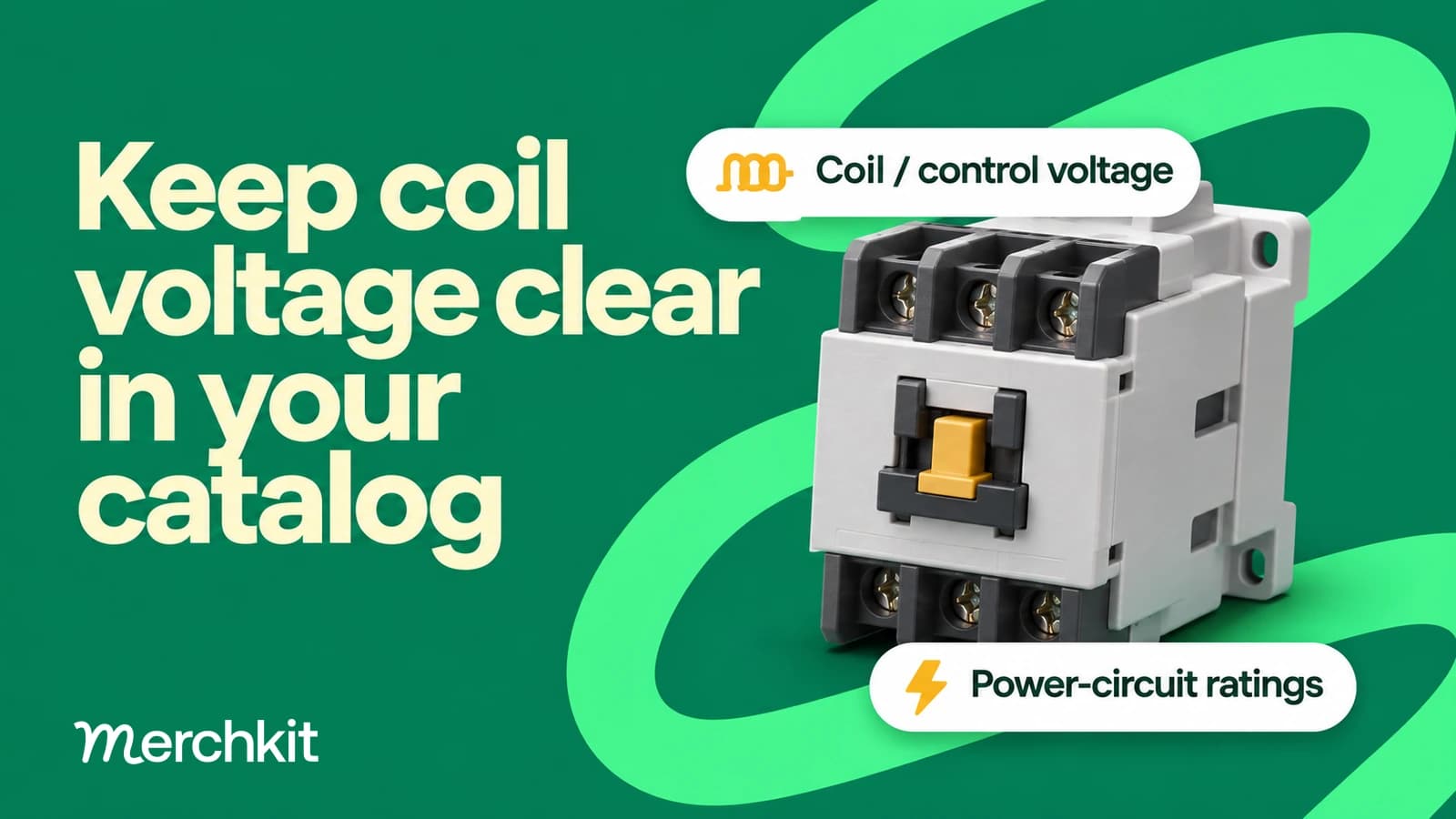
A contactor uses a control circuit to operate contacts that switch another circuit. Those circuits can have different voltage requirements. Label the filter “Coil/control voltage” when that is the intended comparison. Where buyers need power-circuit ratings, provide a separate, clearly named field with the manufacturer’s conditions. Otherwise, buyers have to reopen the data sheet just to understand the comparison.
Read the labels before extracting the numbers
Manufacturers may distinguish control circuit voltage, often labeled Uc, from rated operational voltage, Ue. Insulation voltage, Ui, and impulse withstand voltage, Uimp, describe other ratings. Keep those source labels rather than mapping every occurrence of the word “voltage” into one attribute. Their appearance on the same product page does not make them interchangeable.
Schneider Electric’s current LC1D09BD specification makes the distinction concrete. It lists control circuit voltage as 24 V DC. Its power-circuit rated operational voltage is listed separately as up to 690 V AC at 25 to 400 Hz, and up to 300 V DC. The page also has separate insulation and impulse-withstand ratings. A summary that calls this a “690 V coil” would assign the power-circuit value to the wrong field. [1]
The voltage entries are only part of the product specification. Current, utilization category and other manufacturer conditions still matter. This article covers catalog representation; product selection, installation and safety decisions require the applicable manufacturer documentation and qualified technical review.
Keep AC, DC and frequency with the right value
A bare “24 V” loses information that can distinguish two otherwise similar products. Record the manufacturer’s voltage type with the coil value. When the source specifies an AC frequency, retain it with that AC rating. Do not copy a frequency from the power circuit into the coil field, or add an AC frequency to a DC-only coil.
A range needs the same care. Rockwell Automation describes the 100-E09EJ01 electronic coil as 24 to 60 V AC at 50/60 Hz, or 20 to 60 V DC. Flattening that into “20 to 60 V AC/DC” would extend the stated AC range below its published lower limit. Keep the two source-defined alternatives together as separate entries. [2]
Part-number suffixes can help, but only with the correct manufacturer reference. Schneider’s coil-code guidance explains examples such as BD for 24 V DC and F7 for 110 V AC at 50/60 Hz. It also describes electronic coils with ranges. Treat that guidance as specific to the covered products, not a universal rule for decoding another supplier’s catalog. [3]
Keep enough source detail to review the listing
For each sellable part, keep the complete manufacturer part number and a source link or document revision beside the extracted values. A practical review record can include:
Coil/control voltage: value or range, AC/DC type, and any stated frequency.
Power-circuit operational voltage: separate entries with their applicable conditions.
Other voltage ratings: named fields for insulation or impulse withstand, when needed.
Review note: missing information, ambiguous labels or conflicting sources.
Keep the original wording available even when you standardize units. That lets a reviewer check whether “max voltage” came from a power-circuit table or an insulation-rating row. If the supplier file contains only “Voltage: 24,” leave the meaning unresolved until the source identifies it. Filling a required field with a plausible interpretation makes the record look finished without answering the buyer’s question.
Check the output as a shopper would. Does the title identify the coil correctly? Does the filter distinguish AC from DC? Does the comparison table preserve the range and its conditions? If a destination offers only one voltage field, inspect that field’s definition before mapping. Keep the additional detail in an appropriate supported field or description instead of guessing what the destination means.
How this gets done in Merchkit
Bring a small contactor sample to a Merchkit demo and evaluate the work your team needs to repeat across supplier files:
Separate the source facts. Ask to demonstrate extracting coil and power-circuit values into different attributes, so reviewers do not have to untangle a mixed voltage field.
Try the difficult cases. Include an AC/DC coil with unequal ranges and a row labeled only “Voltage.” Check how missing or ambiguous information is presented for your team’s review.
Review the buyer-facing copy. Compare proposed titles and filter values with the exact source, keeping approval with the people responsible for the catalog.
Check the destination mapping. Inspect how the approved meanings carry into your intended output before expanding the workflow to more suppliers.
Explore this workflow in a Merchkit demo using your own contactor records. [4]
Frequently asked questions
Is coil voltage the same as load voltage?
Coil voltage describes the control supply that operates the contactor. Power-circuit ratings describe the circuit it switches. Store them separately and retain the manufacturer’s conditions.
Can a 24 V DC coil have AC power-circuit ratings?
Yes. The LC1D09BD example has a DC control-voltage entry and separate AC and DC power-circuit ratings. That does not make its coil an AC/DC coil. [1]
Should AC and DC ranges share one minimum and maximum?
Only when the source supports the same range for both. If the published limits differ, keep separate AC and DC entries, as in the Rockwell example. [2]
Can insulation voltage fill a missing operational-voltage field?
No. Preserve the rating’s identity. Ask for the applicable operational rating rather than substituting a different voltage number from the same data sheet.
Can I infer coil voltage from a part-number suffix?
Use a verified decoding reference for that manufacturer and product family, then confirm the exact item. Similar-looking suffixes across suppliers are not sufficient evidence. [3]
What if a supplier provides only one unlabeled voltage?
Keep the source value for review and request its meaning. Do not assign it to coil, power-circuit or insulation voltage merely because one destination field is empty.
Sources
[1] Schneider Electric / Pro-face, LC1D09BD product specification. Checked November 4, 2026.
[2] Rockwell Automation, 100-E09EJ01 product details. Checked November 4, 2026.
[3] Schneider Electric, coil voltage codes for contactors and relays. Last modified August 14, 2026; checked November 4, 2026.
[4] Merchkit demo.