For almost two years, our engineering & product teams have been leading our work to answer a question furniture & home goods teams know too well: can Wayfair catalog management actually be automated by a system, rather than just having that system point out what is missing?
The answer starts with the reality that the product information you need to submit a listing already exists. It just exists everywhere.
Dimensions are in factory spec sheets. Carton data is in an ERP export. Materials are buried in PDFs. Images live in a shared drive. A product page has some of the story. Someone on the merchandising team has the rest.
Then all of it has to be translated into the exact classes, attributes, accepted values and media requirements Wayfair expects, kept current, and repeated every time the catalog changes.
This is the update I have wanted to write for almost two years:
Merchkit is now a Certified Wayfair Catalog API partner, listed on Wayfair’s vendor marketplace.
A supplier can now take the product information it already has, turn it into Wayfair-ready content in Merchkit, create products, and push media through Wayfair’s Catalog API.
The point is not that we made the spreadsheet faster. It is that the spreadsheet no longer has to be the operating system for the catalog, and that the work can finally be automated.
Why this took two years
Wayfair has built one of the richest product taxonomies in home. That richness is useful to shoppers, but it creates a difficult data problem for suppliers.
A manufacturer rarely keeps its internal product data in the same structure Wayfair needs. A dining table may have the right dimensions somewhere, finish details somewhere else (emails?), carton information in another system, and photography in a folder that has never been connected to the product record.
The upload was never the hardest part. Building a trustworthy Wayfair-ready record from all of those sources was. We built Merchkit to have AI automate that work.
Wayfair’s new Catalog API has made it possible to create products and publish media programmatically. Our work was to build the layer around that API that manufacturers actually need: one that starts with messy source data and ends with a channel-specific, trustworthy product record.
Merchkit ingests the source material a supplier already has:
- Factory spec sheets
- Product PDFs
- ERP exports
- CSVs
- Factory photography
- Product pages
- Other source systems
It then:
- Maps each product to the right Wayfair class
- Extracts or generates the required content
- Maps free-form supplier values to Wayfair’s accepted values
- Prepares media
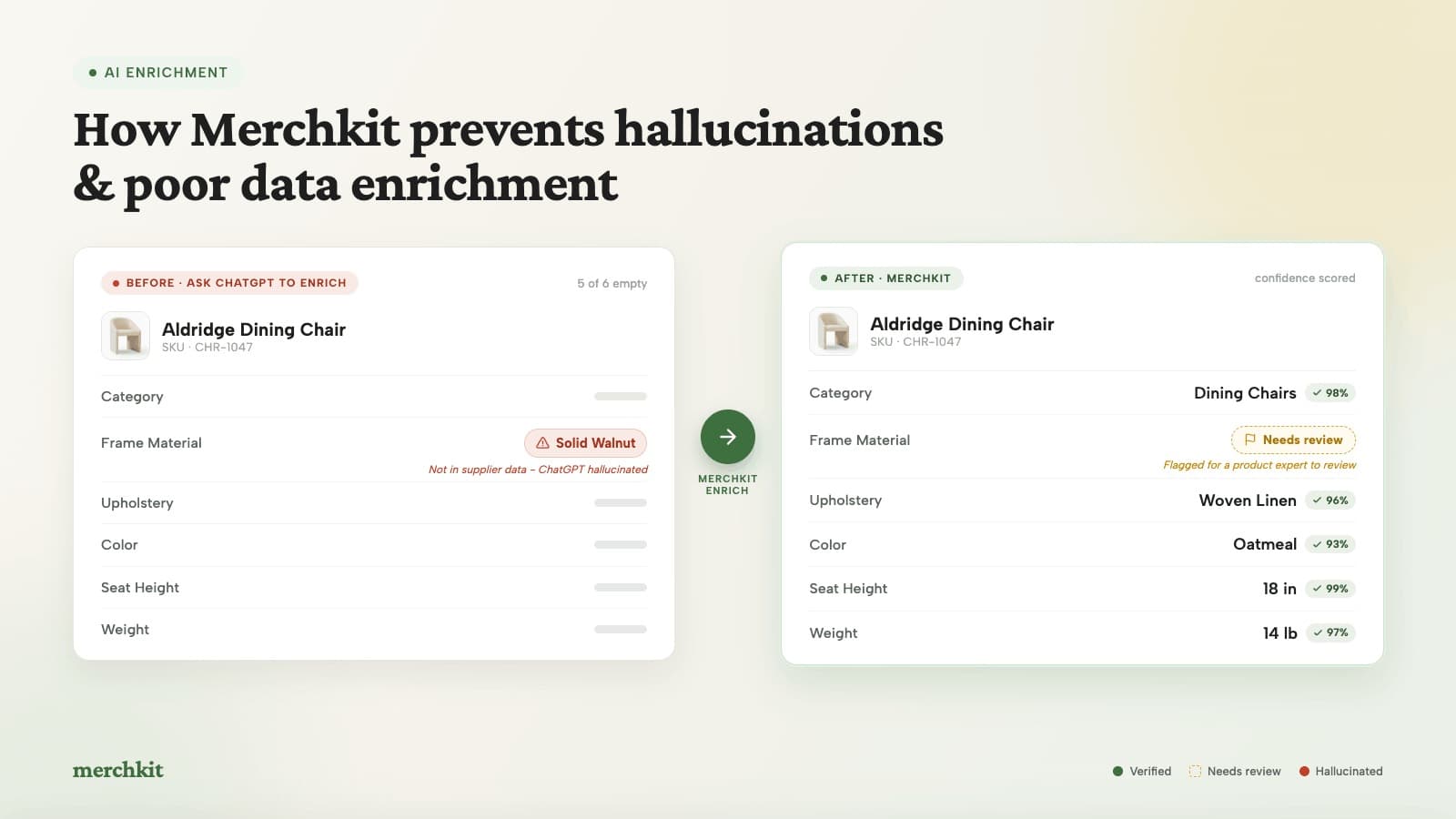
- Provides source citations and generation details to support review
- Surfaces the places where source data is genuinely incomplete or uncertain
For a typical manufacturer, more than 90% of Wayfair’s required attributes can be filled automatically from existing factory spec sheets and factory photography. Results depend on the quality and completeness of those source materials.
Your team reviews incomplete or uncertain information, including compliance and certification documents.
Then new product records and media go directly through the Catalog API.
What the workflow looks like now with Merchkit
1. Start with the catalog you already have
No cleanup project first. No need to force everything into a new system before you begin. Spec sheets, ERP exports, PDFs, images, product pages and spreadsheets are all valid starting points.
2. Merchkit builds the Wayfair-ready product record
Products are mapped to the correct Wayfair classes. Common and class-specific attributes are filled. Supplier language is mapped to accepted values. Waymore content, copy, and imagery are prepared and optimized for the channel.
Newly AI-written product details can include cited sources and generation details, giving your team something specific to check before using the content.
3. Your team reviews exceptions, not every field
The merchandising team works on the small set of things that actually require judgment rather than manually reconstructing every product record.
4. Merchkit creates and publishes new catalog content through Wayfair’s API
New products are created and media is pushed directly through the Catalog API. Merchkit creates and optimizes Wayfair-ready and Waymore content. Partner Home remains available for areas outside the catalog, including orders and reviews.
Manufacturers using the integration
Universal Furniture is one of the first manufacturers running the workflow in production.
Legacy Classic Furniture, Lilola Home, Aspen Home and Martin Furniture are among the other manufacturers already using the integration, showing the breadth of teams adopting it.
Furniture is exactly where we wanted to prove this. Deep catalogs, class-specific attributes, complex dimensions, upholstery options, freight data and large image libraries are what make manual catalog operations break at scale.
What still needs a human
We do not create compliance or certification documents.
Test reports, flammability certificates, emissions documentation and other compliance records have to come from the supplier and its factories.
Your team remains responsible for reviewing the required compliance records and supplying any missing documents before submitting products.
That is by design. The goal is not to remove people from catalog management. It is to stop using people for work software can do reliably, so they can focus on the exceptions that actually require judgement & expertise.
The bigger opportunity
For a lot of furniture teams, the Wayfair conversation has been dominated by operations:
- How do we get these products listed?
- Which attributes are missing?
- Why did this file fail?
- Who is fixing the images?
- Which version of the template is current?
When those questions stop consuming the team, a better one takes their place:
How do we make the product content more complete and effective once it is live?
That is where this gets strategically interesting for us.
Wayfair’s taxonomy will continue to evolve as shopping and discovery change. Richer, more complete, and more specific product records give Wayfair more information to classify, filter, and present a product accurately, and give AI shopping experiences better structured information when shoppers ask for something specific.
So our ambition with Wayfair is not just faster publishing.
It is to give furniture manufacturers a system for continuously improving the completeness and channel-specific quality of the product content that represents them on Wayfair.
Automation buys back the time. The payoff is more complete attributes, stronger channel-specific content, better discoverability, and better conversion opportunities.
See it work
We are hosting a live walkthrough on November 10, 2026 at 2:00 PM ET to show the workflow on a real furniture catalog.
We will take a real catalog through the workflow, show what gets automated, show what gets flagged, and answer questions about how the integration works in practice.