The rules changed. Most retailers haven't noticed yet.
For twenty years, ecommerce ran on the same playbook: pick the right keywords, rank on page one, buy ads to fill the gaps. The game was discovery. Get found, get clicked, get the sale.
That game is over.
When a shopper asks ChatGPT "what's the best running shoe for flat feet under $150?" or tells Amazon's Rufus "find me a sectional sofa that fits a 10x12 living room," they're not browsing a list of blue links. They're getting a direct answer. A curated shortlist. Sometimes a buy button right there in the conversation.
The shift isn't subtle. It's not some future trend to "keep an eye on." Every major commerce channel is already running its own AI model: Amazon Rufus, Walmart's Sparky, ChatGPT Shopping, Google AI Overviews, Meta AI Shopping, and Reddit's AI-powered search. Each one pulls product data differently. Each one has its own logic for what makes the cut and what gets ignored.
The old question was: "How do I rank for this keyword?"
The new question is: "How do I become the relevant answer to this person's actual question?"
That's a different problem entirely. And it requires different product data to solve.
The catalog data problem nobody talks about
Most product catalogs were built to be compressed, not comprehensive.
Two decades of optimizing for Google taught retailers to strip product data down to the essentials. Short titles stuffed with keywords. Bullet points designed for scanners, not readers. Minimal attributes because more fields meant more work and the old algorithms didn't reward the effort anyway.
That worked fine when search engines just needed to match keywords. But AI shopping agents don't match keywords. They reason about your product, compare it against alternatives, and make a judgment call about which one best answers the shopper's question.
And they can only reason with what you give them.
If your product card says "Blue Widget - Large" and your competitor's card says "Cobalt blue ceramic planter, 14 inches tall, drainage hole included, suitable for indoor or outdoor use, fits standard 10-inch pot" -- guess which one the AI recommends when someone asks for "an indoor planter that won't leak on my hardwood floors?"
Your product isn't excluded because it's worse. It's excluded because the AI literally cannot tell what it is.
How AI shopping engines actually evaluate your products
It's worth understanding what happens behind the scenes, because it changes how you think about catalog data.
When a shopper asks an AI agent a product question, the model doesn't just search a database. It runs through a reasoning chain: it pulls from a knowledge graph of product relationships, reads your actual PDP data and attributes, considers the customer's context and intent, then synthesizes all of that into a recommendation.
That reasoning chain evaluates your product across four layers:
Mapping. Can the engine even identify what your product is? If your product title says one thing, your category says another, and your SKU maps to the wrong variant, you're out before the evaluation starts. We've seen cases where a four-person tent shows up in search results for a two-person tent because the SKU mapping was wrong. The brand had no idea.
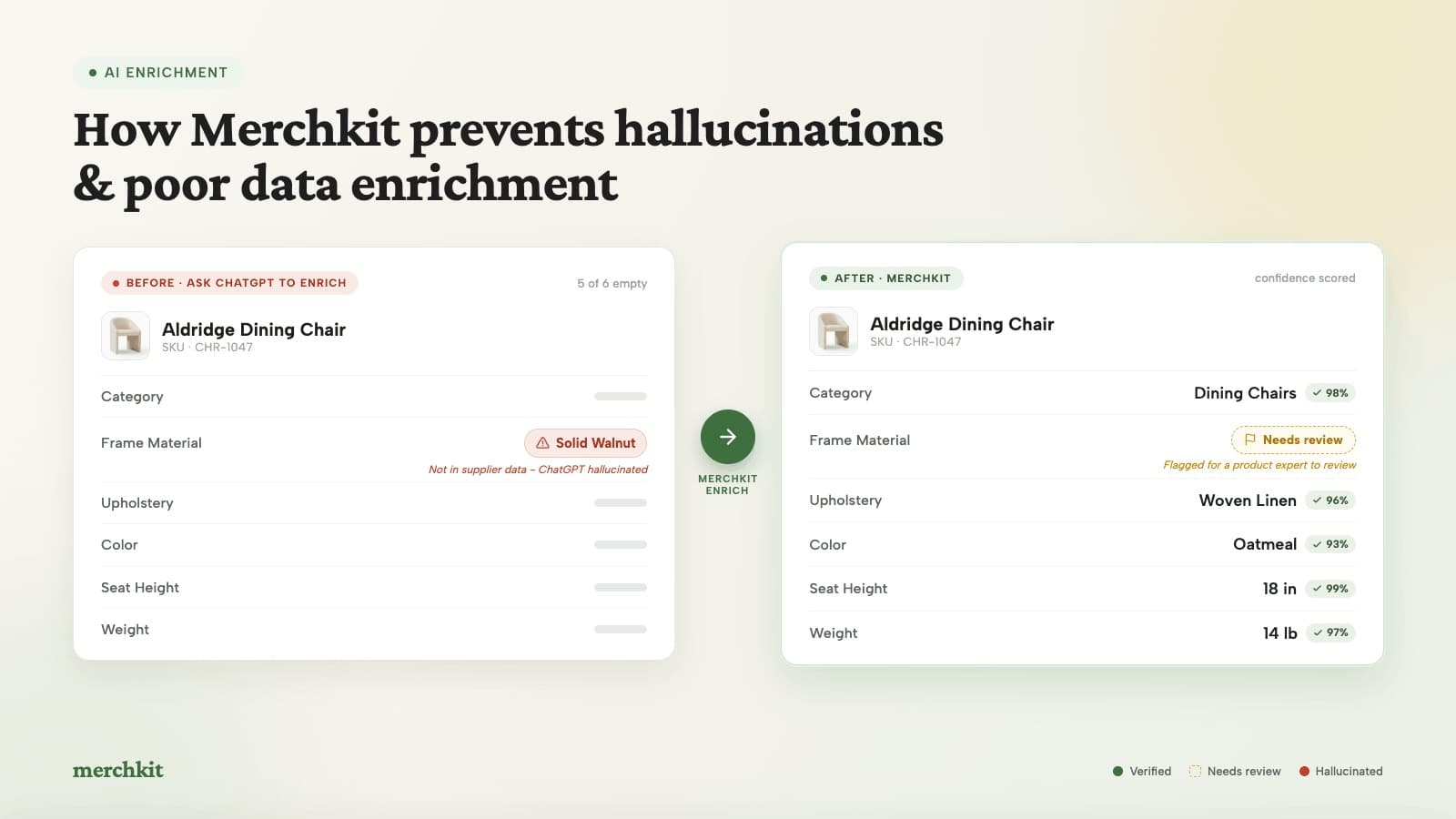
Attributes. Can the engine compare your product against alternatives using structured data? Price, dimensions, material, color, compatibility -- if these fields are empty or inconsistent, the AI has nothing to work with during comparison. One retailer had a bike listed without the brand or model in the title. Perplexity couldn't surface it for any branded query.
Attribute-level context. Can the engine reason about why a specific attribute matters for this shopper's needs? "Waterproof" is an attribute. "IPX7 rated, tested in sustained rainfall for 30 minutes" is context that helps an AI explain why your jacket is the right pick for someone hiking in the Pacific Northwest.
Product-level context. Does the engine have reviews, FAQs, and use-case descriptions that help it build a narrative around your product? A jewelry brand had great reviews on their site but none of that data showed up in their product feed's structured markup. The AI models couldn't see it, so those products looked unreviewed.
Weakness at any layer means silent exclusion. Your product doesn't get flagged or demoted. It just never appears.
The errors hiding in plain sight
The product card errors we see across retail catalogs aren't edge cases. They're systemic. Here are the patterns that show up again and again:
Titles that confuse rather than clarify. A product listed as "JK-4500 BL LG" might mean something to the warehouse team, but it tells an AI nothing. When the brand name, product type, and key differentiators aren't in the title, the product becomes invisible to any natural language query.
Variant mapping disasters. A backpack available in four sizes shows the wrong image for two of them. The medium shows the large's photo. The price for the small pulls from a discontinued colorway. Each variant looks like a different product to an AI model, and none of them look right.
Missing or wrong units. A clothing brand lists "size_type: Regular" for every product regardless of whether it's actually regular, petite, or plus. An outdoor brand lists dimensions without specifying inches or centimeters. The AI can't compare what it can't standardize.
Pricing field errors. A major electronics retailer lists a camera at $49.99 in the product feed when the actual price is $499.99. A decimal point error that makes the product look like a pricing anomaly, which AI models tend to filter out as suspicious.
Stale inventory data. Products listed as in-stock that haven't been available for months. AI models that surface out-of-stock products burn user trust fast and learn to deprioritize those sources.
None of these errors show up in traditional SEO audits. Your Google rankings might be fine. Your paid ads might be performing. But your products are sitting out the fastest-growing shopping channel because the underlying data is broken.
From SEO to GEO to Agentic Commerce Optimization
If you've spent any time in ecommerce, you've watched the optimization discipline evolve. SEO was about ranking for keywords. GEO -- Generative Engine Optimization -- extended that into making your content appear in AI-generated answers, not just traditional search results.
But there's a next step that goes beyond both, and it's where the real leverage is for product catalogs.
Agentic Commerce Optimization is the practice of making your products eligible, competitive, and well-represented across AI shopping agents. It's not just about getting your content into an AI answer (that's GEO). It's about making sure that when an AI agent is actively shopping on behalf of a customer -- comparing products, evaluating options, making purchase recommendations -- your products have the data required to make the cut.
ACO operates upstream of ranking and paid placement. It governs how your products are represented in feeds and product cards before any recommendation engine even considers them.
The distinction matters because it changes what you optimize. SEO optimized pages. GEO optimized content. ACO optimizes the product itself, or more precisely, the data that represents your product across every surface where an AI might evaluate it.
What "good" actually looks like
To make this concrete, consider a mid-market furniture brand selling a modular outdoor sofa.
Three different shoppers ask three different AI agents three different questions:
A young couple asks ChatGPT: "What's a good outdoor sofa for a small apartment balcony that's easy to clean?" An interior designer asks Google's AI Overview: "Modular outdoor seating options with weather-resistant fabric for a commercial hospitality project." A facilities buyer asks Amazon's Rufus: "Outdoor sectional, commercial grade, ships in under two weeks to the Northeast."
Same product. Three completely different evaluation criteria.
The brand that wins all three has a product card with: accurate dimensions (so the AI can judge if it fits a balcony), material and care details (so it can recommend it as easy-to-clean), commercial-grade certifications (so it qualifies for the hospitality query), shipping and availability data (so it makes the two-week cutoff), and enough contextual content for the AI to build a different recommendation narrative for each shopper.
The brand that has a product card saying "Outdoor Modular Sofa - Grey - Ships Free" wins zero of those three.
This is how the AI reasoning chain works in practice. The model reads the shopper's question, identifies the criteria that matter (balcony-sized, easy to clean, commercial grade, fast shipping, whatever the question demands), then scans product data for evidence that a given product meets those criteria. No evidence, no recommendation. The AI doesn't guess. It doesn't give you the benefit of the doubt. If the data isn't there, the product isn't there.
The difference isn't marketing. It's data infrastructure.
How to optimize your product catalog for agentic commerce: a practical playbook
The shift from SEO to ACO can feel abstract, so here's a concrete step-by-step for getting your catalog ready. Think of this as the order of operations -- each step builds on the one before it.
Step 1: Audit your product cards against AI requirements
Forget your SEO checklist for a moment. Pull a sample of 50-100 of your top-selling products and score them against what AI engines actually evaluate: Is the product title clear enough that someone (or something) reading it for the first time would know exactly what the product is? Are all key attributes populated -- dimensions, materials, weight, compatibility, care instructions? Are variants mapped correctly -- right image, right price, right inventory for each size/color/option? Is there structured review data in your markup, or are reviews only visible on your site?
Most teams that run this exercise for the first time find that 30-40% of their top products have at least one critical data gap.
Step 2: Fix your product mapping and taxonomy
Before you touch a single product description, make sure the foundational data is right. This means verifying that your products are categorized correctly in every feed, that SKUs map to the right variants, and that your taxonomy aligns with what each channel expects. A product miscategorized as "camping equipment" when it's actually "backyard furniture" will never surface for the right queries, no matter how good the description is. This is the plumbing. It's not exciting, but nothing else works until it's right.
Step 3: Fill attribute gaps at scale
Once your mapping is clean, tackle the missing attributes. Go channel by channel and identify which required and recommended fields are empty or inconsistent across your catalog. For a few dozen products, this is a spreadsheet exercise. For hundreds or thousands of SKUs, you need automated enrichment -- AI tools that can infer missing attributes from existing product data, images, and specifications, then populate them in a standardized format across your feeds.
Step 4: Add contextual content that helps AI agents reason
This is where most catalogs fall short. Attributes tell an AI what your product is. Context tells it why your product is the right answer for a specific shopper. That means adding use-case descriptions ("ideal for small apartment balconies"), care and maintenance details ("machine washable, air dry"), compatibility notes ("fits all standard 10-inch pots"), and FAQ content that answers the questions shoppers actually ask. The goal is to give AI models enough material to build a recommendation narrative, not just a spec sheet.
Step 5: Optimize for each channel's AI model separately
Your product data doesn't look the same everywhere, and neither do the AI models evaluating it. Amazon Rufus weighs different attributes than Google AI Overviews. ChatGPT Shopping pulls from different data sources than Perplexity. Review your product cards on each channel individually and tailor your content to what that specific AI values. A one-size-fits-all feed strategy worked when you were just matching keywords. It doesn't work when each channel has its own reasoning engine.
Step 6: Build structured data and schema markup into your PDPs
AI models that crawl the web rely heavily on structured data to understand your products. Make sure your product detail pages include complete JSON-LD schema with pricing, availability, reviews, ratings, product identifiers (GTIN, MPN), and FAQ markup. If your reviews live on your site but aren't in your structured data, AI models can't see them. That jewelry brand we mentioned earlier? Thousands of five-star reviews, completely invisible to every AI shopping engine because they weren't in the markup.
Step 7: Set up ongoing monitoring and governance
This isn't a one-time project. Channel requirements change. AI models update their evaluation criteria. New products get added with incomplete data. Existing products go out of stock or get repriced. You need a system -- whether it's automated tooling or a dedicated team rhythm -- that continuously monitors your product data quality across channels and flags issues before they silently cost you sales. Track your agentic commerce referral traffic as a baseline and score product cards against competitor versions regularly.
Step 8: Assign clear ownership
The hardest step, and the most important one. Decide who in your organization owns product data quality across all channels. Not as a side project. As a core function. If this responsibility is split between merchandising, ecommerce, marketing, and your feed tool vendor, nobody actually owns it -- and the gaps between those teams are exactly where the data breaks.
The window is open
According to Bain & Company, agentic commerce could represent $300 to $500 billion in U.S. online retail sales by 2030 -- roughly 15 to 25 percent of total ecommerce. That's not a rounding error.
Right now, most retailers are still optimizing for the old game. Their catalogs are built for keyword matching. Their data infrastructure is designed for traditional feeds. The brands that fix their catalog data now won't just be ready for what's coming -- they'll convert better today, because every improvement to product data quality also improves your traditional search performance, your on-site conversion, and your marketplace listings.
The work isn't glamorous. It's fixing variant mappings and filling in missing attributes and making sure your product titles actually describe the product. But it's the work that determines whether your products exist in the next generation of shopping or not.
The retailers who get their catalog data right won't just be positioned for agentic commerce. They'll see improvements today: better conversion on their own site, stronger performance on marketplaces, fewer returns from mismatched product expectations. Good product data pays dividends everywhere. AI shopping just makes the cost of bad data impossible to ignore.
At Merchkit, this is the problem we work on every day. We help retailers clean, enrich, and optimize their product catalog data so it performs across every channel, including the AI-powered ones. If you want to see where your catalog stands, get a free product card audit. We'll show you exactly what the AI models are seeing and what they're missing in your product data.
Frequently asked questions
What is Agentic Commerce Optimization (ACO)?
ACO is the practice of making your products eligible and competitive across AI shopping agents like ChatGPT Shopping, Amazon Rufus, and Google AI Overviews. Unlike SEO (which optimizes pages for search rankings) or GEO (which optimizes content for AI-generated answers), ACO focuses on making sure your product data is complete, accurate, and contextualized enough for AI agents to recommend your products when shoppers ask questions.
How is AI search different from traditional ecommerce search?
Traditional search matches keywords to products. AI search reasons about products. When a shopper asks an AI agent a question, the model evaluates your product data across multiple dimensions -- mapping, attributes, context, and reviews -- to determine whether your product is a good answer to that specific question. This means products can be silently excluded from AI results even if they rank well in traditional search.
What product data fields matter most for AI shopping engines?
The basics still matter -- accurate titles, correct pricing, in-stock inventory -- but AI engines also weigh structured attributes (dimensions, materials, compatibility), contextual content (use cases, care instructions, FAQs), variant accuracy (correct images and pricing per variant), and review data in structured markup. Gaps in any of these areas can result in your products being excluded from AI recommendations.
How do I know if my products are showing up in AI search results?
This is one of the harder problems to solve because most AI shopping engines don't provide visibility into why products are excluded. Start by searching for your products in ChatGPT, Perplexity, and Google AI Overviews using natural language queries your customers would use. If your products aren't appearing for queries they should match, your product data likely has gaps.
Can I optimize my catalog for AI search manually?
For a handful of products, manual optimization is feasible. But at scale -- hundreds or thousands of SKUs across multiple channels -- manual approaches break down. Each AI engine evaluates data differently, and keeping product cards complete and accurate across all of them requires automated enrichment and monitoring tools.