How to Automate Your Product Catalog and Eliminate Manual Pain Points
Product catalog automation uses AI and integrated workflows to manage, enrich, and distribute product listings across multiple sales channels — without manual effort. Here's how it solves your biggest operational challenges.
The average retailer spends over 15 hours each week on manual catalog tasks. That's time that could be spent on strategic growth instead of spreadsheet maintenance.
Product catalog automation eliminates the most common (and most costly) frustrations in catalog management. Use the 9 high-impact pain points below that AI-powered catalog automation solves, so you can launch faster and scale your business.
1. Excel hell
Managing product catalogs in spreadsheets is a headache. Nobody enjoys repetitive copy-and-paste work, much less broken VLOOKUPs and XLOOKUPs.
And doing it all manually means human errors are inevitable. When you're juggling fabric swatches, wood finishes, assembly instructions, and weight specifications across thousands of SKUs, staying accurate and consistent becomes challenging.
A typo in a dimension field can result in customer returns. A missed cell in a pricing update can cost thousands in margin erosion.
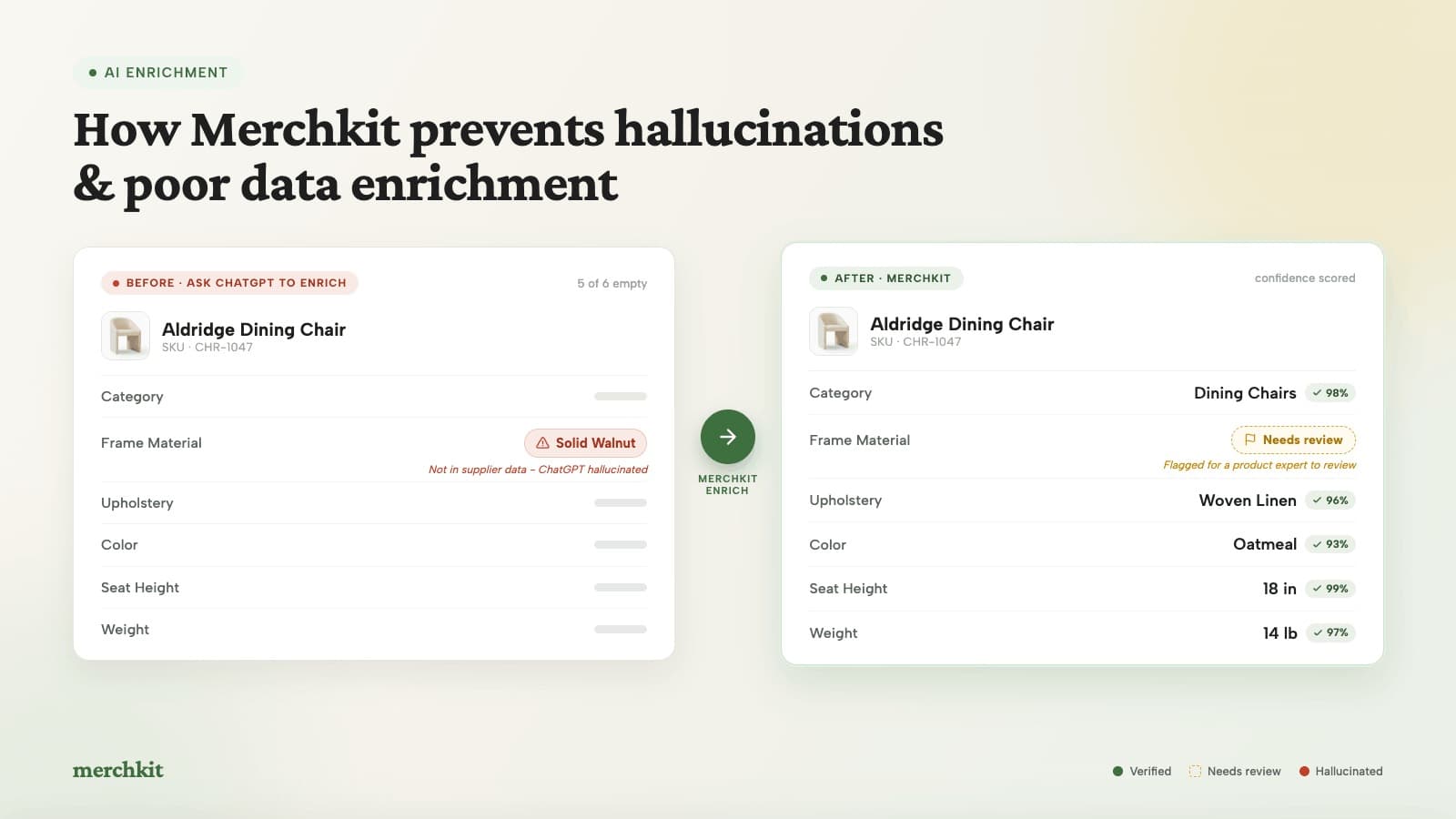
MerchKit Fix:
Replace your spreadsheets with Merchkit, a centralized product information management system built specifically for catalog management.
- One source of truth for your master catalog. Ditch version control issues and searching for the most recent spreadsheet.
- No more manual entry. Product updates automatically sync to all of your sales channels.
- Automated lookups with no error codes. The system handles data relationships and validations automatically, eliminating broken formulas.
The Result: Instead of spending hours maintaining spreadsheets and double-checking formulas, you manage everything from a single interface designed for how businesses actually work.
2. Multi-channel time sinks
Wayfair wants bullet points structured one way. Amazon has character limits and backend search terms. Houzz needs specific image formats. Walmart demands certain compliance fields.
Every channel has unique formatting requirements, and manually customizing each product listing multiplies your workload.
MerchKit Fix:
MerchKit automatically formats product data to each channel.
- One master catalog. Upload your product data once and manage everything from a single system.
- One-click publishing to all channels. Launch products across every platform simultaneously instead of channel-by-channel uploads.
- Automatic channel-specific optimization. Titles, descriptions, and metadata are automatically customized for each platform's algorithm, character limits, and formatting requirements.
The Result: Launch products across all channels simultaneously instead of staggering rollouts over weeks. No more tracking which channels have been updated and which still need work.
3. Inconsistent pricing across channels
Pricing is complex. You're managing wholesale pricing, MAP policies, promotional discounts, and channel-specific fees. Every retailer has different margin requirements. Every marketplace has different fee structures.
When you're running a promotion or adjusting margins, updating hundreds or thousands of SKUs across multiple platforms becomes a multi-day project and errors or delays lead to inconsistent pricing across channels.
MerchKit Fix:
MerchKit centralizes your pricing strategy so updates happen instantly across every sales channel.
- Set pricing rules per channel. Define your margin requirements, promotional strategies, and channel-specific adjustments in the system.
- Push pricing updates across all platforms. Update prices in your master catalog and changes are applied across all sales channels.
The Result: Pricing updates that used to take days now happen in minutes, with zero risk of cross-channel inconsistencies or pricing errors that hurt customer trust.
4. Expensive product photography
Professional photography for dimension images, feature callout images, etc can cost hundreds per SKU, with costs multiplying for every variation. But accurate photos are key for both making sales and preventing returns.
MerchKit Fix:
MerchKit uses AI to generate the visual assets you need without the per-SKU photography costs.
- Product feature callouts specialized per channel. Upload images optimized for each retailer's requirements and audience preferences.
- Lower-cost visuals for every variation. Create images for all fabric and finish options without additional photoshoots.
The Result: Generate the visual assets you need without the hefty bill. Create variations for every finish option and channel-specific imagery instantly.
5. Time-consuming image management
Once you have images, you need to store them, organize them, and share them with retail partners. That means hours creating Dropbox folders or FTP image links. When a retailer requests updated product images, you're digging through folders and hoping you're sending the right version.
MerchKit Fix:
MerchKit centralizes image storage and eliminates manual link creation.
- Automatic image links. The system generates shareable URLs instantly without manual folder management.
- Centralized image library. Every stakeholder accesses the same up-to-date assets without digging through folders.
The Result: Image management that used to take hours per week now takes minutes. No more folder archaeology or sending outdated files to retail partners.
6. Maintaining content quality at scale
Writing unique content for every SKU on every platform isn't realistic when you're managing thousands of products manually. You end up delaying launches, increasing headcount to keep up, or publishing the generic descriptions.
MerchKit Fix:
MerchKit generates product content that adapts to each channel's requirements.
- AI-generated titles, descriptions, and bullets. Get content based on your product data and brand guidelines.
- SEO and GEO optimizationbuilt in. Merchkit optimizes descriptions to help products rank in search results and AI shopping searches.
- Channel-specific formatting. Content is automatically adapted to each platform's requirements while maintaining your brand voice.
The Result: Quickly launch product content across every channel, optimized to show up how and where consumers are searching.
7. Lagging product launches
Adding a new collection across platforms takes weeks when done manually. By the time products are live everywhere, you've already missed early-season demand.
Competitors with faster systems capture sales while you're still updating spreadsheets and waiting for retailer approvals.
MerchKit Fix:
MerchKit eliminates the channel-by-channel launch process.
- Load once, launch everywhere. Create your product data in one place and distribute to all channels from a single platform.
- Go-to-market in hours. Launch quickly, so products are in front of customers while seasonal demand is at its peak.
The Result: Never miss sales due to delayed launches. Capture the full seasonal selling window instead of missing the best weeks.
8. Endless channel compliance errors
Every marketplace has unique standards and acceptable values for their various fields and attributes. And when you don't meet them, you're troubleshooting error codes.
It can take hours to fix all of the failed uploads, and in the meantime, you're losing revenue.
MerchKit Fix:
MerchKit validates your data before submission to eliminate the error cycle.
- Automated validation. Ensures data meets each channel's requirements before you submit.
- Errors flagged and corrected upfront. Fix issues once instead of through multiple failed upload attempts.
The Result: Products go live on the first submission. No more wasting time troubleshooting error codes or resubmitting failed feeds.
9. Minimum Advertised Price (MAP) messes
Protecting your brand value means enforcing Minimum Advertised Price (MAP) policies across all retail partners. But monitoring compliance manually doesn't scale.
You can hire expensive monitoring services or spend hours manually searching for violations. Either way, by the time you catch a retailer selling below MAP, they've already eroded your margins and brand positioning.
MerchKit Fix:
MerchKit automates MAP monitoring so you catch violations in real-time.
- Set monitoring channels once. Define which retailers and marketplaces to track.
- Get automated alerts when MAP is violated. Get notified immediately when pricing drops below your threshold.
The Result: Protect your margins and brand integrity without hiring a monitoring service or doing manual price checks across every sales channel.
Bonus: No capacity for video
Getting products launched with the basic requirements is a whirlwind, and "nice to have" assets don't make the to-do list. But with a more efficient system, you can do more.
Product videos significantly boost engagement and conversion rates, but creating them traditionally requires videographers, editing software, and hours of production time you don't have.
MerchKit Fix:
Add automated video creation to your plan for a low-lift way to boost revenue.
- Custom videos in 60 seconds. Get 3-7 second product videos curated in under a minute.
The Result: Professional product videos for every SKU without the time and cost of traditional video production.
Stop losing time to manual catalog work
High-quality product cataloging can be simple and efficient, even when you're optimizing products for multiple sales channels.
MerchKit gets your product catalog live in hours, not weeks, with:
- Data syncing
- AI content generation
- Automated compliance checks
- Channel formatting
- SEO and GEO optimization
- Optional video production
Grow your business with faster launches, fewer errors, stronger brand control, and optimized visual content. All from one platform, built specifically for catalog management.
Ready to get 15+ hours back every week? See how MerchKit transforms catalog management from your biggest bottleneck into a competitive advantage.
FAQ
What is product catalog automation?
Product catalog automation is the use of software and AI to automatically create, update, enrich, and distribute product listings across multiple sales channels. It eliminates manual data entry and ensures consistent, optimized content at scale — without increasing headcount. Learn more in our definitive guide to product catalog automation.
How much time does manual catalog management actually take?
The average retailer spends over 15 hours per week on manual catalog tasks. For context, Merchkit customers like Daniel House reduced their time spent onboarding 200 SKUs from 40 hours per month to just 30 minutes, while scaling to 1,000 SKUs per month.
What's the difference between catalog automation and a PIM?
A PIM (Product Information Management) system is primarily a storage and organization tool. It centralizes your product data but still requires manual effort to format and distribute it. Catalog automation goes further by automatically customizing, optimizing, and publishing that data to each sales channel without manual intervention. See our guide to AI-powered PIM tools for a deeper comparison.
What sales channels can catalog automation publish to?
Catalog automation tools like Merchkit can publish to direct-to-consumer websites, B2C marketplaces (Amazon, Wayfair, Walmart, Houzz), B2B distributors, offline retail partners, and AI shopping platforms. Each channel receives content formatted to its specific requirements automatically.
How does catalog automation help with SEO?
Catalog automation tools with built-in AI generate product titles, descriptions, and metadata with high-performing search terms woven in naturally — without requiring manual keyword research. This helps products rank higher in both traditional search engines and AI-powered shopping searches.
What is GEO optimization for product listings?
GEO (Generative Engine Optimization) refers to optimizing product content to appear in AI-generated answers from tools like ChatGPT, Perplexity, and Google AI Overviews. This includes adding FAQs, contextual use cases, and structured content that AI systems can easily interpret and surface to shoppers. Read our complete guide to optimizing your catalog for AI search and conversational commerce to learn more.
What causes channel compliance errors in eCommerce?
Channel compliance errors occur when product data doesn't match a marketplace's required format, character limits, attribute values, or mandatory fields. Each platform has different standards, and manually formatting data for each one makes errors nearly inevitable. Automated validation catches these issues before submission.
What is MAP, and why does it matter for catalog management?
MAP stands for Minimum Advertised Price. It's the lowest price at which a retailer is permitted to advertise a product. Enforcing MAP policies protects brand value and margin. Catalog automation tools can monitor MAP compliance across all retail partners in real-time and send alerts when violations occur.
Can catalog automation work for small catalogs, or only large ones?
Catalog automation delivers value at any catalog size, but the ROI increases with scale. Even at 50–100 SKUs across multiple channels, the time saved on formatting, compliance, and publishing adds up quickly. As catalogs grow into the thousands of SKUs, automation becomes essential rather than optional.
How long does it take to implement catalog automation?
Implementation timelines vary, but tools like Merchkit are designed to get your catalog live in hours rather than weeks. A typical approach is to start with a pilot of 50–100 SKUs on two channels, validate results, then roll out across your full catalog and additional platforms.